ROUTINE MAINTENANCE NOTICE: We're making improvements behind the scenes! Some forms may be temporarily unavailable while we complete updates. Thank you for your patience and the work will be wrapped up the afternoon of Sept. 28th.


Healthcare organizations are operating in an increasingly complex environment. Staffing shortages, financial pressures, workforce mobility, and growing regulatory expectations have made frontline readiness a strategic priority for health systems nationwide. At the same time, leaders are expected to ensure consistent, high-quality clinical performance across expanding enterprises that span multiple sites, specialties, and care settings.
Yet many organizations still rely on skills validations and compliance activities as proxies for readiness, commonly referred to as “skills checklists.” While these tools remain important, they do not fully answer a critical question: Is a clinician truly prepared to provide safe, effective care in practice?
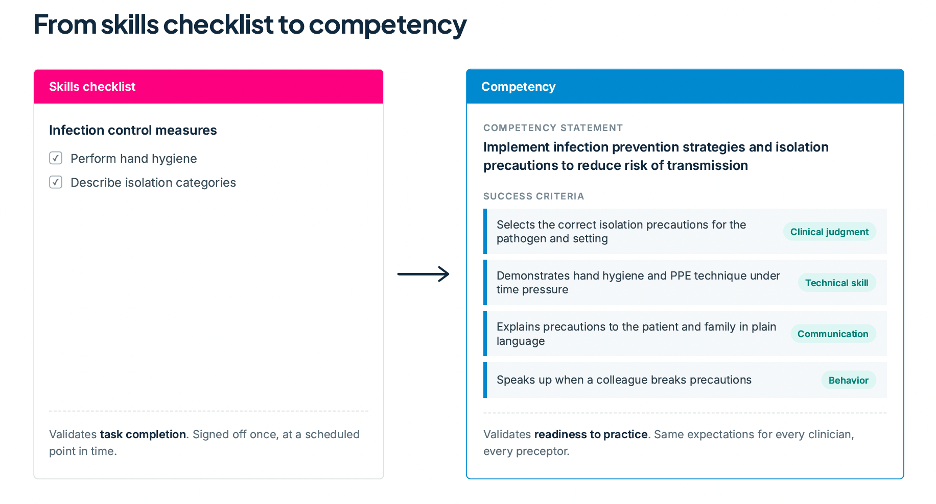
A completed skills checklist may verify that a nurse has performed a procedure, but it does not necessarily demonstrate their ability to recognize subtle patient deterioration, prioritize competing demands, communicate under pressure, or apply sound clinical judgment in unfamiliar situations.
As healthcare organizations invest heavily in workforce development, the conversation is shifting from documenting task completion to measuring workforce readiness.
Clinical competencies define the knowledge, skills, clinical judgment, professional behaviors, and performance expectations required for clinicians to deliver safe, high-quality patient care. Together, they form the foundation of clinical competency development and provide a framework for evaluating workforce readiness across healthcare organizations.
At their best, competencies create a consistent, shared understanding of what readiness looks like across an organization while providing leaders with visibility into workforce strengths, gaps, and development needs.
In many healthcare organizations, clinical competency and skills management still relies on spreadsheets, paper documentation, disconnected systems, and learning management systems that only validate knowledge or completion. These limitations give way to variation and duplication across specialties and sites and often make competency tracking difficult, limiting leaders' ability to understand true workforce readiness across roles, units, and sites.
Healthcare organizations often use the terms skills, competency criteria, and competencies interchangeably. While closely related, they represent distinct layers of practice assessment and validation.
Consider a common driving analogy: a skills checklist can verify mirror adjustment, turn signal use, and parking ability. The criteria for safe driving might include maintaining situational awareness, following traffic laws, anticipating hazards, and making appropriate decisions in changing conditions. Competency is the ability to bring all of those elements together to consistently and safely operate a vehicle in the real world.
The same principle applies to healthcare. Technical skills and procedural validations remain important, but true clinical competence requires clinicians to integrate those skills with clinical judgment, communication, prioritization, and appropriate action across a wide range of patient care situations.
The ultimate goal of competency validation is not proving that someone completed training but instead proving they are truly ready for practice. Organizations that recognize this distinction are moving beyond measuring task completion and transforming into modernized, system-wide competency models.
Healthcare organizations are at a pivotal moment in how they define, develop, and validate clinical readiness.
Evidence of the problem emerged in 2025, when an attendee survey at the AONL (American Organization for Nursing Leadership) Annual Conference found that 83% of nursing leaders reported variability in training and competencies among same-level nurses within their organizations.
Even more telling, 91% said that overhauling RN competencies would significantly improve consistent quality care.
By 2026, attention had shifted from acknowledging the problem to prioritizing action. A market research survey conducted by Ascend Learning found that 85% of nursing leaders plan to overhaul RN competencies within the next two years, citing a desire to move from "check-the-box annual compliance to meaningful, continuous competency development.”
What was once viewed as a workforce development challenge is increasingly being recognized as a strategic imperative.
Several market forces are accelerating that shift. Health systems continue to navigate mergers, acquisitions, and regional expansion while working to establish consistent clinical practice across sites, specialties, and patient populations. At the same time, rising patient acuity requires clinicians who can consistently apply clinical judgment, communication, prioritization, and decision-making in increasingly complex care environments.
Workforce demographic changes are also reshaping readiness and development. New graduate nurses represent a critical source of workforce growth, while retirements continue to reduce institutional knowledge and experienced preceptor capacity.
At the same time, Gen Z nurses are seeking clearer development pathways, more meaningful feedback, and greater transparency around professional growth. Together, these trends are driving demand for competency frameworks that can accelerate readiness while supporting ongoing professional development.
Financial constraints are further raising the stakes. With the One Big Beautiful Bill Act (OBBBA) projected to increase the uninsured population by roughly 10 million people by 2034, health systems are preparing for higher levels of uncompensated care while managing largely fixed operating costs1.
As a result, leaders are increasingly focused on optimizing their largest controllable expense: clinical labor.
In this environment, a modernized competency development framework and management system become a financial strategy as much as a quality one — faster time to readiness, internal flexibility in place of premium agency hours, and stronger retention.
Historically, modernizing competencies to address these growing challenges required significant manual effort that was difficult to sustain.
Today, advances in technology are making competency transformation achievable at scale.
Healthcare organizations increasingly recognize that modern competencies must accomplish two goals simultaneously:
The organizations leading competency transformation are moving beyond traditional compliance models and adopting a more comprehensive approach built around four foundational elements:
Many traditional competency programs focus primarily on procedural validation and knowledge assessment, often relying on a time-based model in which clinicians progress according to predetermined schedules regardless of individual readiness.
Modern competency-based development expands beyond technical execution, deliberately evaluating clinical judgment, attitudes, behaviors, communication, prioritization, and decision-making against clearly defined expectations. This approach creates a more accurate picture of clinical readiness and provides a stronger foundation for workforce development decisions.
Clearly defined, outcomes-driven competency criteria also create greater consistency in evaluation. Preceptors across the organization gain a shared understanding of what readiness looks like and what clinicians must demonstrate before being validated as competent. This reduces reliance on assumptions, individual interpretation, and bias.
A modern nursing competency framework should bring together professional practice standards, patient safety expectations, quality priorities, and regulatory guidance into a unified approach to readiness. Recommended practice standards might include organizations and governing bodies such as The Joint Commission, NPG, CMS, QSEN, Quality Indicators, NAHQ, IPEC, and state regulatory bodies.
Importantly, aligning competencies and criteria to multiple evidence-based standards is not mutually exclusive with adopting a competency model such as Benner's Novice-to-Expert framework, TSAM, and other models. These models can be highly effective competency-based onboarding processes and are further supported by an integrated evidence-based framework for competency and criteria.
Many competency programs can become bloated over time. Clinicians spend valuable time working through competencies that are not directly tied to readiness while repeatedly validating capabilities they have already demonstrated elsewhere.
Modern competency architecture takes a different approach: a strong clinical competency framework starts with the competencies most critical to role readiness and progressively builds from there.
StaffGarden's competency philosophy, for example, organizes competencies across three progressive layers: foundational competencies, multispecialty competencies, and specialty competencies.
Rather than functioning as isolated requirements, these competency layers build upon one another. Foundational competencies establish readiness. Multispecialty competencies extend that readiness across related practice environments. Specialty competencies build advanced expertise where it is needed most.
Most importantly, competencies validated in earlier foundational layers are carried forward, not re-validated within each role transition, reducing duplication, accelerating readiness, and supporting more efficient role transitions over time.
Because what is already proven is known, the net-new competencies for the next level are explicit and communicable, so nurses and leaders alike know what advancement requires. Assignment happens automatically, as the right competencies are mapped to each role, removing a major manual mapping burden for Nursing Professional Development managers.
This strategic structure unlocks impactful competency portability, referring to the ability to recognize and build upon demonstrated competence across roles, units, specialties, and sites.
This matters because healthcare organizations are increasingly dependent on workforce flexibility, yet when clinicians move between units, departments, hospitals, or specialties, organizations frequently repeat competency validations that have already been completed elsewhere. Every hour spent relearning or revalidating competencies that have already been demonstrated represents non-productive time for both the clinician and the organization.
A more effective approach is to recognize validated competencies and focus only on the gaps unique to the new role, patient population, or practice setting. True competency portability becomes possible when competencies are consistently named, consistently defined, consistently measured, and intentionally designed to build upon one another across the organization.
When technology, modernized competency content, and progressive competency architecture work together, organizations gain the ability to:
Competency portability helps organizations maximize the value of every development investment while creating a better experience for clinicians throughout their careers.
Competency data becomes far more valuable when it extends beyond competency validation itself. In many organizations, competencies, clinical ladders, workforce planning, succession planning, mentorship programs, Magnet® initiatives, and professional development efforts operate in separate systems and workflows, limiting visibility and alignment across the organization.
A connected frontline development ecosystem brings these efforts together through a shared foundation built on consistent competency definitions, criteria, and validation data. The same competencies used to assess readiness can also support clinical ladder advancement, identify future leaders, inform workforce planning, strengthen mentorship programs, provide evidence for Magnet® initiatives, and help leaders make more informed workforce planning decisions.
When competencies become the organization's shared source of truth, development becomes more connected, consistent, and strategic. Leaders gain a clearer view of workforce capabilities and future needs, while clinicians benefit from more transparent growth and career pathways.
Most healthcare leaders recognize that competency transformation is necessary.
The challenge is that meaningful change requires time, expertise, governance, alignment, and sustained effort.
For many organizations, the journey to transformation can take two to three years — a laborious process demanding significant time and resources.
For large healthcare organizations, this work can span multiple years. The good news is that organizations no longer have to start from scratch.
StaffGarden by Ascend Learning combines experienced Nursing Professional Development advisors with an already-developed, evidence-based competency framework.
Our Evidence-Based RN Competencies are built on decades of research and validation through Versant Healthcare Competency Solutions and evolved to the latest practice standards in collaboration with Larissa Africa, MBA, RN, CENP, FAAN, FAONL — former Versant CEO and now VP of StaffGarden Healthcare Workforce Solutions.
Rather than spending years developing competency and criteria from the ground up and mapping out a progressive blueprint, organizations can work with experienced NPD consultants to begin from a proven foundation and adapt it to their specialties, patient populations, workforce needs, and organizational priorities.
The future of workforce development lies beyond skills checklists. True competency is defined by who can establish the clearest competency expectations, validate readiness most effectively, reduce variability in care, and help clinicians continuously build competence throughout their careers.
Learn how StaffGarden helps healthcare organizations modernize clinical competency management, improve workforce visibility, and accelerate workforce readiness through evidence-based competency development.
1 Rowe, S., & Sopp, B. (2026, August). The State of Healthcare 2026 [Presentation]. Union Healthcare Insight.

As a leader in ensuring quality, safety, and efficiency in patient care, your role is vital. Sign up to receive Insights in your inbox and get monthly updates, expert perspectives, and practical information to empower your team and elevate patient care.
Ready for a Modern Approach to Clinical Success?
